The Madras High Court is one of the oldest and most respected High Courts in India. Located in Chennai, Tamil Nadu, the court serves as the highest judicial authority for the state of Tamil Nadu and the Union Territory of Puducherry. It handles civil, criminal, constitutional, commercial, and administrative matters across its jurisdiction.
Established in 1862 during British rule, the Madras High Court is one of the three original Chartered High Courts of India, along with the Bombay High Court and Calcutta High Court. The court is famous for its Indo-Saracenic architecture, historic legacy, and landmark constitutional judgments.
| Particulars | Details |
| Established | 26 June 1862 |
| Principal Seat | Chennai, Tamil Nadu |
| Additional Bench | Madurai Bench |
| Jurisdiction | Tamil Nadu and Puducherry |
| Type | Chartered High Court |
| Main Functions | Civil, Criminal, Constitutional Cases |
| Official Language | English |
| Sanctioned Judge Strength | 75 Judges |
| Historic Court Building Opened | 1892 |
| Official Website | hcmadras.tn.gov.in |
History of Madras High Court
The judicial history of Madras dates back to the British East India Company era. Before the establishment of the High Court, judicial administration in Madras functioned through Mayor’s Courts, Recorder’s Courts, and later the Supreme Court of Madras established in 1817.
After the British Parliament passed the Indian High Courts Act, 1861, Queen Victoria issued Letters Patent creating the High Court of Judicature at Madras on 26 June 1862. The Madras High Court officially replaced the Supreme Court of Madras and the Sadr Diwani Adalat system.
The court initially functioned from temporary buildings between 1862 and 1892. Later, the present High Court complex in Chennai was officially inaugurated on 12 July 1892. The building remains one of the largest judicial complexes in the world.
The court has a rich judicial legacy and produced several eminent judges. Sir T. Muthuswamy Iyer became the first Indian judge of the Madras High Court, while Justice P. V. Rajamannar later became the first Indian Chief Justice after independence.
In 2004, a permanent bench of the Madras High Court was established at Madurai to improve judicial access for southern Tamil Nadu districts.
Over the decades, the Madras High Court has delivered important judgments related to:
- Constitutional rights
- Environmental protection
- Education policies
- Administrative law
- Commercial disputes
- Freedom of speech
Jurisdiction of Madras High Court
The Madras High Court exercises wide powers under the Constitution of India.
Original Jurisdiction
As a Chartered High Court, the Madras High Court has original jurisdiction over Chennai city in important civil and commercial matters.
These include:
- Commercial disputes
- Admiralty matters
- Testamentary matters
- Matrimonial cases
- Intellectual property disputes
Appellate Jurisdiction
The court hears appeals from subordinate courts and tribunals across Tamil Nadu and Puducherry.
It handles:
- Civil appeals
- Criminal appeals
- Sessions court matters
- Family court appeals
- Tribunal appeals
Writ Jurisdiction
Under Article 226 of the Constitution, the Madras High Court can issue writs for protection of legal and fundamental rights.
Citizens can approach the court against:
- Illegal government actions
- Administrative irregularities
- Constitutional violations
- Public authority decisions
Supervisory Jurisdiction
The High Court supervises all subordinate courts functioning within Tamil Nadu and Puducherry and ensures proper judicial administration.
Structure of Madras High Court
The Madras High Court functions under the leadership of the Chief Justice along with permanent and additional judges appointed by the President of India.
According to official information, the sanctioned strength of the court is 75 judges including the Chief Justice.
Principal Seat and Bench
The court functions through:
- Principal Seat at Chennai
- Permanent Madurai Bench
The Madurai Bench handles appellate matters from several southern districts of Tamil Nadu.
Types of Cases Handled
The court handles:
- Civil disputes
- Criminal cases
- Constitutional matters
- Tax disputes
- Land disputes
- Commercial litigation
- Public Interest Litigations
Digital Facilities
The Madras High Court provides modern judicial facilities including:
- E-filing system
- Online case status
- Digital cause lists
- Virtual hearings
- Video conferencing facilities
Madurai Bench of Madras High Court
The Madurai Bench was inaugurated on 24 July 2004 to improve judicial accessibility in southern Tamil Nadu.
The bench handles matters from districts including:
- Madurai
- Tirunelveli
- Thoothukudi
- Dindigul
- Ramanathapuram
- Sivaganga
- Karur
- Thanjavur
Except for original jurisdiction matters, the Madurai Bench exercises powers similar to the principal bench at Chennai.
Court Building and Architecture
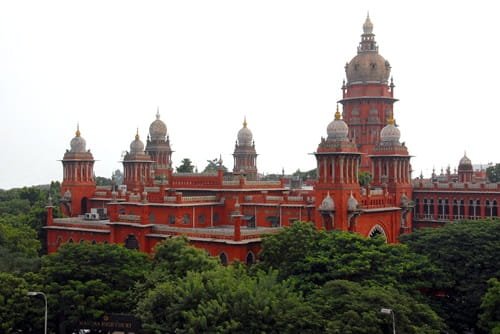
The Madras High Court building is one of Chennai’s most famous heritage structures. Designed in Indo-Saracenic style, the building combines Indian, Islamic, and European architectural influences.
Important features include:
- Red sandstone structure
- Decorative domes and arches
- Historic courtroom halls
- Lighthouse tower within the campus
- Colonial-era judicial chambers
The court complex covers nearly 107 acres and is considered one of the largest court complexes in the world.
Importance of Madras High Court
The Madras High Court is one of the most influential courts in India because of its long constitutional history and judicial contribution.
The court regularly handles important matters related to:
- Constitutional governance
- Environmental law
- Education disputes
- Commercial litigation
- Urban development
- Public administration
In recent years, the court has passed important rulings related to university appointments, encroachments, and property disputes.
The court is also known for preserving certain colonial traditions such as ceremonial silver maces carried before judges.
Address of Madras High Court
Official Address
High Court of Judicature at Madras
Parry’s Corner
Chennai, Tamil Nadu – 600104
Official Website
FAQs
Q1. When was the Madras High Court established?
The Madras High Court was established on 26 June 1862 under the Indian High Courts Act, 1861.
Q2. Which areas come under Madras High Court?
The court has jurisdiction over Tamil Nadu and the Union Territory of Puducherry.
Q3. Why is the Madras High Court famous?
The court is famous for its historical importance, Indo-Saracenic architecture, and landmark constitutional judgments.
Q4. Does the Madras High Court have a bench?
Yes, the court has a permanent bench at Madurai established in 2004.
Q5. What is the sanctioned strength of judges in Madras High Court?
The sanctioned strength of the court is 75 judges.
Q6. Does the Madras High Court provide online services?
Yes, it provides e-filing, online case status, virtual hearings, and digital cause lists.
Q7. What style is the Madras High Court building built in?
The building is constructed in Indo-Saracenic architectural style.